
Trading on Hyperliquid
Understanding Perpetual Contracts
Explain Like I'm 5:
Perpetual contracts are like betting on the price of something without actually buying it. It's like saying "I bet this toy will cost more tomorrow" without buying the toy. If you're right, you win money. If you're wrong, you lose money.
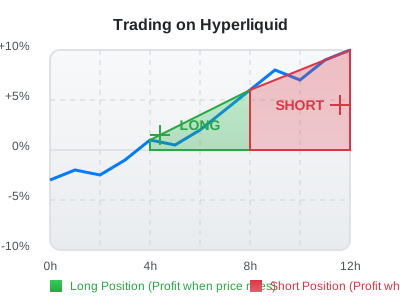
Hyperliquid offers perpetual futures contracts (or "perps") for over 100 different crypto assets. Unlike traditional futures that expire on a specific date, perpetual contracts can be held indefinitely.
Going Long
When you "go long," you're betting that the price will increase. If the price goes up, you make a profit. If it goes down, you lose money.
Going Short
When you "go short," you're betting that the price will decrease. If the price goes down, you make a profit. If it goes up, you lose money.
Leverage and Margin
Hyperliquid allows you to trade with leverage, which means you can control a larger position than your actual collateral. Different assets have different maximum leverage, ranging from 3x to 40x.
Example
If you have $100 of collateral and use 10x leverage, you can open a position worth $1,000. This amplifies both potential profits and losses.
Order Types
Explain Like I'm 5:
Order types are like different ways to tell the store what you want to buy or sell. You can say "I want it right now" (market order), "I'll buy it when the price is lower" (limit order), or "If the price reaches this point, then buy it" (stop order).
Hyperliquid offers several types of orders to give you flexibility in how you trade:
Market Order
An order that executes immediately at the current market price. Use this when you want to enter or exit a position quickly.
Limit Order
An order that executes at the selected limit price or better. Use this when you want to buy at a lower price or sell at a higher price than the current market.
Stop Market Order
A market order that is activated when the price reaches the selected stop price. Typically used to limit losses or lock in profits.
Stop Limit Order
A limit order that is activated when the price reaches the selected stop price.
Scale Order
Multiple limit orders in a set price range. Useful for gradually entering or exiting a position.
TWAP (Time-Weighted Average Price)
A large order divided into smaller suborders and executed in 30-second intervals. Useful for large orders to minimize market impact.
Order Options
Reduce Only
An order that reduces a current position as opposed to opening a new position in the opposite direction.
Good Til Cancel (GTC)
An order that rests on the order book until it is filled or canceled.
Post Only (ALO)
An order that is added to the order book but doesn't execute immediately. It is only executed as a resting order.
Immediate or Cancel (IOC)
An order that will be canceled if it is not immediately filled.
Liquidations
Explain Like I'm 5:
Liquidation is like when you're playing a game and run out of lives - the game ends automatically before you can lose more than you have. When the price moves too far against your position, the system automatically closes it to make sure you don't lose more than your collateral.
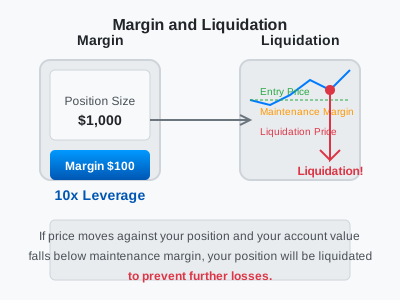
A liquidation event occurs when a trader's positions move against them to the point where the account equity falls below the maintenance margin. The maintenance margin is half of the initial margin at max leverage.
For example, if an asset has a max leverage of 20x, the maintenance margin is 2.5% of the position size.
How Liquidations Work on Hyperliquid
- When your account equity drops below maintenance margin, your positions are first attempted to be entirely closed by sending market orders to the order book.
- If the positions are closed such that the maintenance margin requirements are met, any remaining collateral stays with you.
- If your account equity drops below 2/3 of the maintenance margin without successful liquidation through the book, a backstop liquidation happens through the liquidator vault.
Important
To avoid liquidations, you can:
- Use lower leverage to give yourself more room for price movements
- Set stop-loss orders to exit positions before they reach liquidation price
- Add more collateral to your account when positions move against you
- Monitor your positions regularly, especially during volatile market conditions